

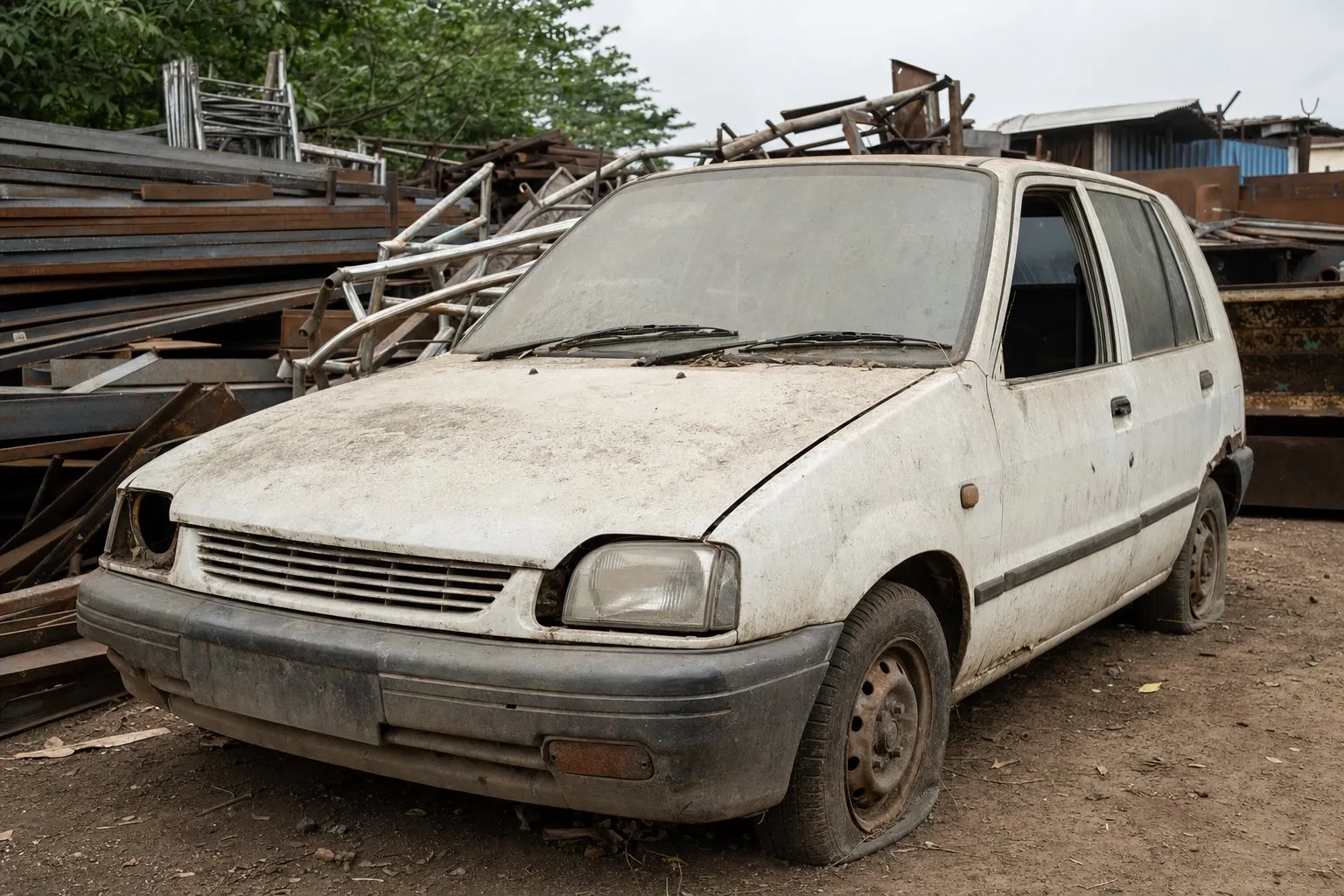
India's Vehicle Scrappage Policy 2021 changed how end-of-life vehicles are retired. An old vehicle is no longer something you sell to whoever turns up with a truck. It is deregistered and destroyed at a Registered Vehicle Scrapping Facility, and the owner gets paperwork that carries real value.
This guide covers what scrapping involves, what you need to bring, and what you get back. If you have a vehicle ready to go, book a pickup and we will handle the process.
What vehicle scrapping actually means
Scrapping is the formal process of permanently deregistering a vehicle and destroying it at a Registered Vehicle Scrapping Facility, usually shortened to RVSF. It is not the same as selling a car for parts, and it is not the same as abandoning it.
The owner receives a Certificate of Destruction, or COD. That certificate is the point of the whole exercise: it is what proves the vehicle has been legally retired and is no longer your responsibility.
What the Certificate of Destruction gets you
| Benefit | What it means |
|---|---|
| Scrap value | Immediate payment based on the vehicle's metal weight and the current rate |
| Green Tax waiver | Exemption from Green Tax when registering a new vehicle of the same type |
| Registration discount | Up to 25% off the registration fee on a replacement vehicle |
| Legal closure | Official confirmation that the vehicle is off your name and out of your liability |
The last one matters more than people expect. Until a vehicle is formally deregistered, it remains registered to you. That is a problem if it is later involved in anything, or if you simply want it off your record.
Documents you need
- RC book: the original Registration Certificate. An expired RC is accepted.
- Identity proof: Aadhaar or PAN of the registered owner.
- Bank NOC: required if the vehicle was bought on a loan and the hypothecation is still recorded.
- Vehicle keys: all available keys, handed over at the time of scrapping.
Lost the RC? Scrapping is still possible with an FIR copy and an NOC from the local RTO. Tell us on the call and we will explain what else is needed.
What a vehicle is worth
Value depends on the vehicle, not on a flat rate. Make, model, year, condition and the current metal market all move the number, which is why a figure quoted without seeing the vehicle is not worth much.
Two-wheelers are the one category where a range is meaningful, because the metal content is consistent: roughly ₹5,000 to ₹6,500 per vehicle. For cars, autos, trucks and buses, send photographs and the RC details on WhatsApp and we will give you a real figure rather than a range.
We will also tell you when a vehicle is worth more intact than scrapped. A running two-wheeler with resale demand is sometimes better sold than destroyed, and it costs us nothing to say so.
How the process runs
- Send us the vehicle details and photographs, and we quote a figure.
- We collect the vehicle from where it stands. It does not need to be running.
- We pay you at the time of collection.
- You cancel the RC on vscrap.parivahan.gov.in as the owner; the invoice we issue is your proof of the sale.
- Any Certificate of Destruction comes from the registered scrapping facility that processes the vehicle, not from the buyer.
A vehicle that will not start is the normal case, not an exception. We bring the recovery vehicle. Seized engines and flat tyres change what the vehicle is worth, not whether we can take it.
RC cancellation, and why you should not skip it
Once you have the COD, the RC is cancelled on the government's Vahan Scrappage Portal at vscrap.parivahan.gov.in. This is the step that formally deregisters the vehicle from your name.
That step is yours, not ours. We buy the vehicle and issue an invoice; we do not file the cancellation. The timeline depends on the portal and the RTO, so budget for it rather than expecting the sale to close it.
A vehicle is not really scrapped until the RC is cancelled. Until then it is still yours on paper.
If you have an old car, bike, auto or commercial vehicle to retire, book a pickup or call +91 97004 36932. We also handle end-of-life vehicle scrapping as a standing service, including accidental, flood-damaged and abandoned vehicles. For a two-wheeler specifically, the bike scrap page has the per-vehicle range and the documents, including what stays with you after the sale.